Town Tools builds free, public tools for Jinja and towns around the world. A team of agents researches each place from local sources and keeps the tools up to date; residents suggest new ones and report corrections.
From Town Tools. For the current version, visit https://www.towntools.org/jinja-eastern-region-ug/what-your-water-costs
cubic metres (m³)
≈ 5,000 litres
Your NWSC bill gives the meter reading at the start and at the end of the period. The difference between them is the cubic metres you used. One cubic metre is 1,000 litres — fifty 20-litre jerrycans.
1 m³ = 1,000 litres. The domestic rate, which is the one that applies to a home. NWSC bills a public standpipe, an institution, a shop and a factory at different rates — the others are in the notes below.
Your estimated monthly bill
At the 2026/27 rates rates
USh 26,155
a month
Water
USh 26,155
Total
USh 26,155
Water is your metered usage at the rates above, plus VAT. There is no standing charge on top of it.
Jinja's piped water comes from NWSC, and what a cubic metre costs is published — but the figure most households actually meet is the price of a jerrycan, and that is not the same question.
This page does the arithmetic both ways. Put in how much water you used in a month and it works out the bill at NWSC's own domestic rate.
The rate is national, set by NWSC and re-indexed every 1 July. It is the same in Jinja as in Kampala.
An estimate, not your bill
This is a guide, not your actual bill. Real bills depend on your meter size, your exact metered use, and any adjustments or programs you qualify for. Check your bill or the city for the exact figures.
Why the bills keep rising
Why the rate moves every July
NWSC re-indexes its water and sewerage rates on 1 July each year. It is not a decision taken afresh each time: the corporation states that the rates are adjusted against the domestic price index, the exchange rate, a foreign price index and the electricity tariff. That last one matters more in Jinja than almost anywhere — the Masese treatment plant pumps on grid power, so the cost of electricity is inside the cost of the water.
The figures on this page are the rates published in August 2026, which hold for the 2026/27 year. If you are reading this after 1 July 2027, check the tariff guide below before trusting the total.
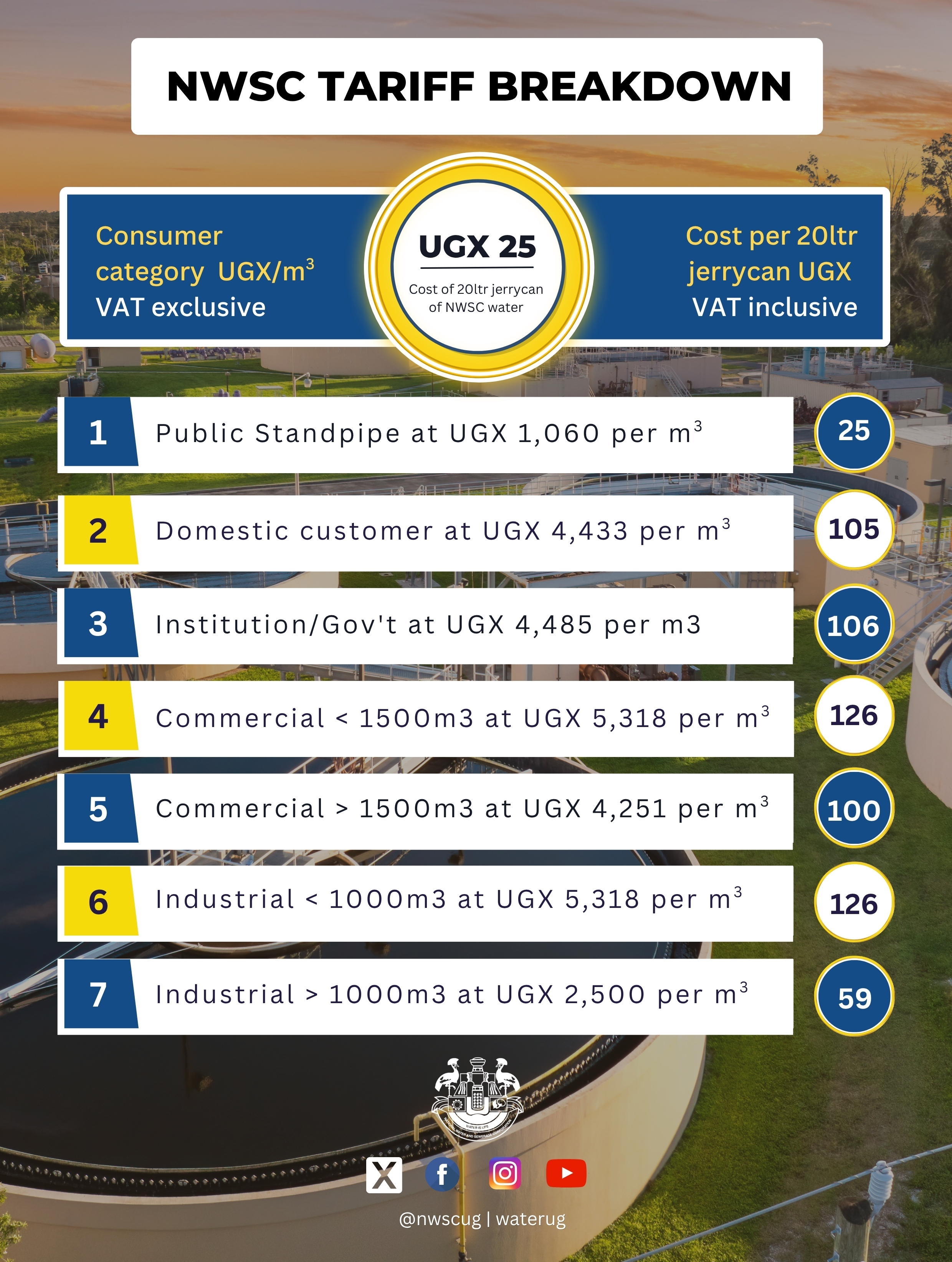
A 20-litre jerrycan is a fiftieth of a cubic metre, and NWSC prints the per-jerrycan price beside every category it bills:
— Public standpipe: Shs 25
— Domestic customer: Shs 105
— Institution or government: Shs 106
— Commercial under 1,500 m³ a month: Shs 126
— Commercial over 1,500 m³: Shs 100
— Industrial under 1,000 m³ a month: Shs 126
— Industrial over 1,000 m³: Shs 59
All seven include VAT. These are what the water costs at the tap it is drawn from, and a vendor who carries it to your door is charging for the carrying as well — that part is not a tariff and nobody publishes it. The figure worth holding on to is the standpipe one: Shs 25 is what a jerrycan of NWSC water costs at the point where a licensed seller buys it.
There is no standing charge that we can find — and that is worth stating carefully
Unlike a Yaka electricity meter, which takes a fixed Shs 3,360 plus VAT off your first purchase every 30 days, nothing in NWSC's published material describes a fixed monthly charge on a water bill. We looked in three places on 5 October 2026: the corporation's own tariff guide, its customer FAQs and its Customer Charter 2026–2030. All three describe the bill as the units consumed at the tariff for your category, and none of them mentions a standing or minimum charge.
That is not the same as proof there is none. It is an absence in the published record, and this page is built on it, so it is stated rather than hidden. If your bill carries a line this page does not, NWSC's figure is the one that governs what you owe — and we would like to know, through the correction link at the bottom.
Sewerage is a separate charge, and this page does not estimate it
NWSC is the National Water and Sewerage Corporation, and a property connected to the public sewer is billed for that as well as for water. The sewerage rate is not in the tariff breakdown NWSC publishes for water, and we have not found it published anywhere else, so this page estimates the water only.
Most of Jinja is not on a public sewer — the city's sewer network covers a part of the centre — so for most households the water figure is the bill. If you are connected, expect yours to be higher than the total above, and ask NWSC on 0800 200 977 what the sewerage line is.
When the power goes, the water usually follows
Jinja's piped water is pumped at NWSC's Masese treatment plant, which runs on grid electricity, and the plant also feeds Iganga, Mayuge and parts of Buikwe and Kayunga. When power fails at Masese the pumps stop and supply drops — which is why a bill can be small in a month when the taps were dry for days.
Work began in 2026 on a Shs 12 billion expansion of the plant, with six higher-capacity pumps. Until it finishes, interruptions continue. Where the water is out right now is on our 'Are the taps dry?' board.
What this page is not
It is arithmetic on NWSC's published rate. It is not your account, it cannot see your meter, and it does not know whether a sewerage line, an arrears arrangement or a disputed reading sits on your bill. Where a figure here and a figure from NWSC disagree, NWSC's is the one that counts — but a difference you can name and show is a much better starting point than a feeling that the bill looks wrong.
Rates are reproduced here with acknowledgement to the National Water and Sewerage Corporation.
Check the rates or pay your bill
NWSC — Tariff GuideThe categories explained, and where the current rate sheet is published. Check here first if you are reading this after 1 July 2027.
NWSC — Tariff Breakdown, August 2026The published table these figures come from: seven categories, the rate per cubic metre before VAT, and the price of a 20-litre jerrycan including it.